Knife is always difficult. In the best of circumstances, controlling the knife is extremely hard. This angle makes it even harder. Two approaches are shown here, but you should ALWAYS consider defending and countering, then breaking away and running or looking for a shield or weapon. This was discussed during the lesson, but missed by the video.

To watch the video, click here.

The Krav Maga Alliance has grown much faster than we anticipated. It really started as an informal training program for close friends. When I parted ways with Krav Maga Worldwide, where I’d been president for 8 years, I kept getting asked for training by people who’d known me as one of the top instructors. As more and more people trained, I began to organize, and founded the Krav Maga Alliance.
One year later, with zero advertising and no business plan, we have 40 affiliates on 3 continents. We have conducted multiple training courses, and we have sponsored one of the best Krav Maga/Firearms courses ever offered: Trial By Firearms in Las Vegas.
And this is only the beginning.
We will have a series of exciting announcements during the next two months. Thanks to a team of dedicated affiliates and friends, we’ve established a strong foundation. Now we are going to building on that foundation.
The first step is the creation of the Alliance Training Team. I want the Krav Maga Alliance to be ten times stronger 5 years on. To do that, we must build the next generation of high level instructors now. To that end, we are beginning to train the Alliance Training Team, which will be composed of Lead Instructors and Instructors. The Team itself will be announced soon, but I promise that every Lead Instructor will have the following credentials:
Our lead instructors will know what it takes to become a Black Belt in Krav Maga, and they will also know what it takes to make it a successful business. I want the next generation of Krav Maga Alliance instructors to be better than I am, more experienced than I am, and more able to help our affiliates grow. That’s how we will become ten times stronger 5 years on.
I hope you’ll help us get there!
This is our next themed training week. Look for some unique training coming to a Krav Maga Alliance school near you!


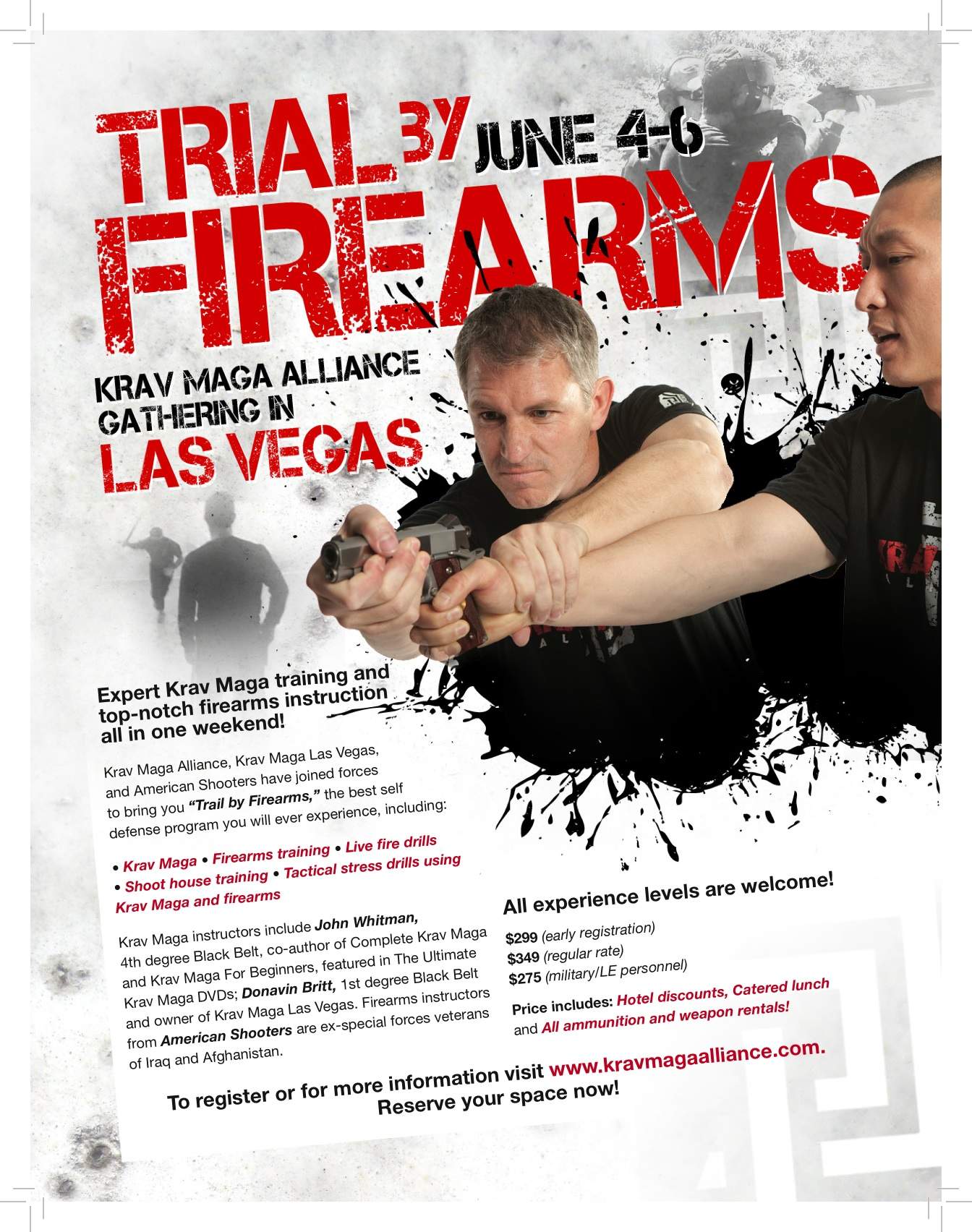
On the weekend of June 4-6, 2010, Krav Maga Alliance hosted the first Alliance Gathering, which we called “Trial By Firearms.” It was co-hosted by our local affiliate, Krav Maga Las Vegas, and American Shooters, a group of ex-operators who also happen to be fantastic firearms instructors.
I do not mean to diminish the experiences offered by many other great Krav Maga seminars, but I must say: in my opinion, this was the best Krav Maga/shooting weekend anyone has offered. The training included live fire, training, move and shoot drills, and the finale: a simunition house that included both contact fighting and simunition firefights. The experience was as real we could make it while maintaining some level of safety. The stress level was extreme, and the participants were tested on every level: awareness, reaction time, recognition, standup fighting, groundfighting, shooting tactics, shooting accuracy, aggressiveness, and an ability to remember details and articulate them clearly.
We had 50 participants, and all of them were high energy. The group dynamic was fantastic, and we could have asked for a better group of attendees. People traveled from Australia and Vancouver, Canada. We met attendees from Texas, Ohio, Idaho, and Michigan.
Training began on Friday with a day of high level Krav Maga training on gun and knife defenses. This training was excellent, but it was only a prelude. On Saturday morning, we broke the attendees into four groups, and each group went through four different sections: High Stress Krav Maga, Basic Live Fire, Advanced Live Fire, and the Sims House. Lunch was provided at no cost on Saturday and Sunday.
I won’t go into detail about the Simunition house. If you want to know the specifics, come next year and try it yourself. Let’s just say that you walked into a building (not a room, a BUILDING), and then had to get back out again, with an unknown number of assailants trying to stop you. You didn’t know how many there were, or where they were hiding. You didn’t know if they were going to lie in wait or come out and find you. It was home invasion training on steroids.
I could not have been more pleased. This is the kind of realistic training I want for the Krav Maga Alliance. All the participants rose to the occasion, and I think everyone learned from the experience.
I hope we see you there next year!

We ran a Level 3 certification in May 2010. The whole group was excellent. They were very technical, energetic, and excellent teachers. They also took a pounding in the fighting portion of the course. Congratulations, everyone!

We just conducted a 2-day seminar in Austin, Texas, with the great people at Fit and Fearless (www.fitandfearless.com). The first day focused on basic self defense and non-compliant attackers. We created drills where the defender starts from a neutral position and defends against some sort of attack such as a choke, bearhug, etc. Once the defender begins to counterattack, the attacker covers and makes a second attack. This begins as an organized drill, but then becomes much more free-form as elements are added.
On the second day, we did advanced training: knife v. knife and third party protection.
There was another instructor doing seminars as well—Rory Miller, author of “Meditations on Violence.” I recommend his book to anyone interested in reading more about real-world approaches to violent conflicts.
The attendees were fantastic and trained very hard! Thanks to Jeff Levine and everyone at Fit and Fearless for being such fantastic hosts!
Come to the Gathering: Trial By Firearms, June 4-6, 2010 in Las Vegas. Join the Krav Maga Alliance, Krav Maga Las Vegas, and the firearms instructors at American Shooters for a weekend of high intensity Krav Maga training, handgun training, and stress drills that involve hand-to-hand combat and firearms. Learn to operate under intense pressure during three days of training with some of the best Krav Maga and firearms instructors in the U.S. Price includes all training, gun rental, ammunition, and Saturday lunch. And, since it’s Vegas, we’re sure we’ll find something fun to do during the down time!
Click here to view the seminar flyer.
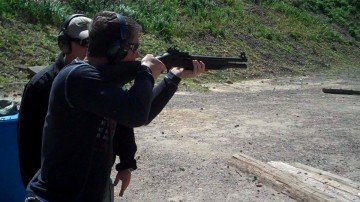
If you want to see where Krav Maga Alliance is headed in terms of training and preparation for a violent encounter, go to the Video Demos and look under Drills. We are not just talking about learning some basic firearms; we are talking about stress drills that incorporate Krav Maga and live firearms. Click on the Video “Krav Maga and Firearms” to see the kind of training we are doing. (Special thanks to Jeremy Stafford, a Krav Maga Black Belt at Simi Valley Krav Maga, and also the instructors at Girls With Guns.)
And this is only the beginning.
(Special thanks to Jeremy Stafford, a Krav Maga Black Belt at Simi Valley Krav Maga, and also the instructors at Girls With Guns.)
Thumb down and forward. That’s all it took to release the strap and draw the weapon from its holster. Thumb down and forward. But I couldn’t do it in the roughly 1.7 seconds it took for the attacker to cover twenty-plus feet. I had to abandon the weapon and go right to Krav Maga’s regular stick defense. You can watch the video
[local /wp-content/uploads/2010/02/Stick-Live-Gun-2.mov]

Even after 19 years of Krav Maga stress training, it still amazes me how small changes in circumstance can affect performance and reaction time.
Now, to discuss this specific situation, let’s make a few basic assumptions. First, that I am a reasonably good athlete with reasonably good hand-eye coordination. Second, that the borrowed holster I was using was secure but not complicated to operate. (I had, in fact, practiced the simple release movement several times while waiting my turn in the stress drill.) Third, that I have reasonably good reaction time when dealing with Krav Maga stick and knife defenses (you will have to take this on faith; I don’t claim to be perfect, but I’ve done this sort of thing for a long time).
The reason I make these assumptions is to identify what I think is the one important factor: the situation was new. It wasn’t complex (the holster was easy to operate). Nor was it particularly stressful for me. It was just new. That “newness” was all that was needed to slow my reaction time enough to change my defense. This is true of all of us. Every new situation tests our abilities. To keep our training true, and to maintain a decent state of awareness, we need to constantly change up our environment and circumstances.
To push yourself, try changing up any of the following factors as often as you can:
Remember, the environment might not be inherently difficult, but the very newness of it will be a factor. The more we take ourselves out of our comfort zone, the better prepared we will be if we are ever confronted by violence.
Hand Position During Front Kick: Up or Down?

I want to talk about hand position during a front kick. Normally, I am reluctant to get so far into the minutiae of a technique. We are in danger of becoming too “martial arty” and dogmatic if we discuss exact positioning, except in those rare instances where exact positioning means the difference between life and death.
I consider this to be old news and common sense (may of you will, too) but it has come up during my recent travels, so it deserves some attention.
The issue is how, and how much, to keep your hands up while delivering a front kick. The general instruction in Krav Maga is to keep your hands up. However, as students learn to involve their hips and deliver a stronger kick, their bodies naturally want to counterbalance by dropping the hand. There is a clear conflict between the Instruction (“Hands Up!”) and the body mechanics (“Counterbalance by dropping the hand”), How to resolve this?
Some students resolve the situation by stubbornly following instructions and keeping their hands up. This is not as good as it sounds. It often learns to an artificial, unnatural posture that reduces the speed and power of the kick. Look at the following examples on video:
These are all good students with decent kicks. However, they have been told (by me, by the way!) to keep their hands up, and they do it with such determination that it stiffens their upper bodies and reduces their freedom of movement. Ultimately, I think it detracts from the kick. Now, we DON’T want them to suddenly drop their hands. This would leave them exposed during a fight. So what do we do?
We compromise. I advocate a little “elbow pump.” The arm wants to move dynamically, so we let it. But instead of dropping the hand all the way down, we let it “pump” a little bit, which helps to counterbalance, adds power to the strike, but keeps the hand relatively close to the action and able to recover immediately.
Here is some video of some successive front kicks. The hand is lower in some than in others. You can decide for yourself if it’s too low, but a greater hand movement does allow for more dynamic and powerful movement.
Again, at the end of the day we can’t become too dogmatic. The point is to kick the bad guy in the groin so he feels like he’s got a tonsil problem, and do it in a way that is relatively safe for us. The difference of a few inches counts in other areas of life, but not so much here. As long as your hands remain available for the fight, I think you’re OK, and I prefer this more dynamic movement. Let me know what you think!
Ready to build a stronger school with better training, better support, and a better network? Click here to submit your info and learn what it means to join the Krav Maga Alliance.